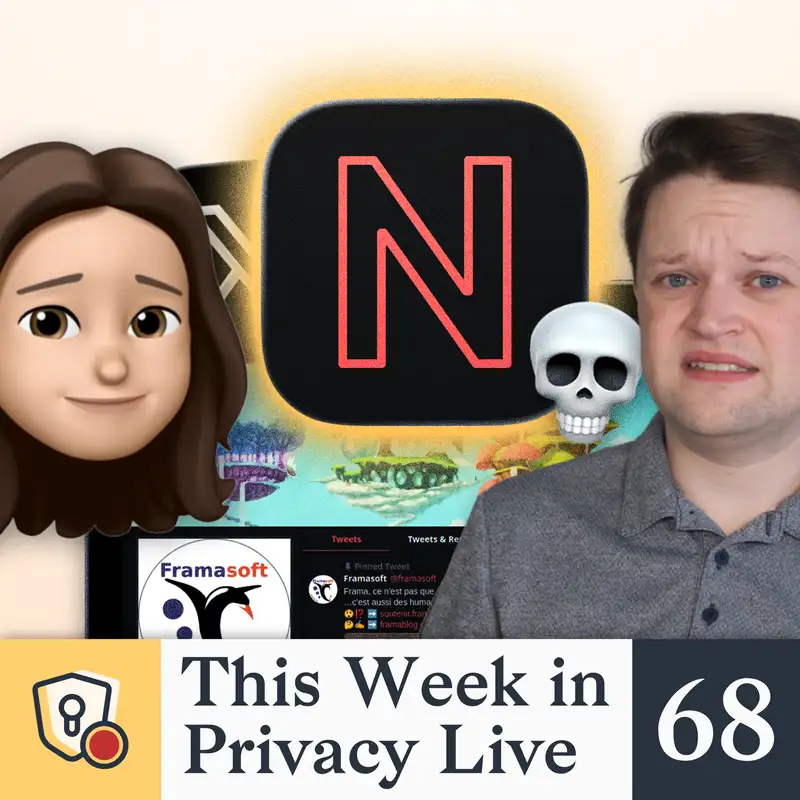
Could This Be The End of Privacy Frontends?
The best way to privately lurk on Twitter
is at risk.
Meta is making major changes to how miners
can use their platforms,
and Windows has some positive updates for
once.
All of this and more is coming up
on This Week in Privacy episode
sixty-eight, so stay tuned.
Welcome back to This Week in Privacy,
our weekly series where we discuss the
latest updates with what we've been
working on within the Privacy Guides
community,
and this week's top stories in data
privacy and cybersecurity while answering
viewer questions.
I'm Jordan,
and with me this week is Jonah.
How are you, Jonah?
I'm doing pretty well.
Pretty uneventful week, I think.
But yeah,
we got some good news to talk about
today.
So yeah, I'm excited about that.
How are you doing, Jordan?
Yeah, good.
Ready to dive into some really interesting
news topics this week.
I guess we can dive straight into the
first story here.
And this is from TechCrunch.
X sends cease and desist to...
open source project knitter over alleged
scraping knitter an open source project
that allowed people to read x posts
without logging in or even opening the x
app has received cease and desist letters
from x demanding that it shut down the
news was shared by a brief message posted
to the project's website and follows x's
early attempts to knock knitter offline by
technical means
The service also powers a number of other
sites, including xCancel,
which allowed people to view X posts
directly.
This isn't X's first attempt to shut down
Knitter.
In twenty twenty four,
Knitter's flagship instance, Knitter.net,
went dark temporarily after X rolled out
new API restrictions.
Knitter worked by fetching public X posts
and then stripping out the ads,
tracking cookies and JavaScript,
giving people a clean and clutter free way
to read posts without an account or the
app.
After the crackdown,
those who wanted to host a Nida instance
had to connect it to a real X
account,
according to the project's GitHub page.
Despite the restrictions,
development picked back up and Nida
instances came back online.
This time,
X is working to shut down Nida and
its instances via legal means.
Nida's website states that the Nida.net
project
is offline while its creator seeks legal
advice after receiving a cease and desist
letter.
That creator,
a developer who goes by the name of
Zedius,
told TechCrunch by email that other NIDA
instances received similar letters.
The letter from X,
which TechCrunch has viewed,
accuses Nitter of an unlawful use and
circumvention of X's application
programming interface and associated data.
Through its service,
saying that X has evidence that Nitter
scraped X data and accessed X accounts and
session tokens in violation of X's rules.
Lawyers for X said the actions are in
violation of various state and federal
laws,
including but not limited to the Texas
Harmful Access by Computer Act and the
Lanham Act.
The letter gave Nita until five p.m.
EST on August twenty fifth to shut down
and they have now shut down.
So I guess we can dive in here
into, you know,
Some discussion questions.
Why is Twitter doing this?
I mean,
Twitter definitely has an interest.
I think we've seen this,
especially from Twitter and Reddit.
They don't want people accessing their
data outside of their apps because they
sell this data to like AI companies and
stuff through their API for training and
for and that sort of purpose.
So all of this free access kind of
through these front ends.
Well,
it's useful for people who just want to
access Twitter.
It's also a way that
They could certainly scrape all of that
data companies if all of that is
available.
And so that's kind of a business interest
that they have in shutting this down.
It's unfortunate because
I think this is going to affect a
lot of people, since unfortunately,
a lot of companies and even news
organizations or government agencies still
post like announcements to Twitter and
official things.
I know that we frequently see like tweets
from the Graphene OS project, for example,
we would see in our communities.
because they post a lot of updates there.
Luckily, in that case,
they also post the same posts pretty much
all the time to their Mastodon.
So they have we have that option to
access it.
But like a lot of similar projects will
not be mirroring their posts to to
Mastodon or other services in the same way
that more privacy focused projects like
like Graphene OS would.
So for a lot of those software projects
or for other organizations,
it's
It sucks because then you really need to
just have a Twitter account,
use their app,
and give away a lot of information just
to read posts that aren't accessible by
any other means.
Because people have not gotten into the
habit of using more than one platform to
post even now, unfortunately.
Yeah, I have seen even like, you know,
US government agencies,
they'll like post updates on Twitter.
And it's like, well,
is that really like it used to be
that Twitter was like the public square or
whatever they used to call it.
And it was like the place where you
go for the updates.
Right.
And everyone could access it.
You didn't need an account.
But now it seems like that's sort of
almost become like Facebook and Instagram.
You do need an account to access Twitter.
basically anything on Twitter without,
you know,
the severe restrictions on what you can
access basically,
which I agree is probably due to scraping.
I mean, Twitter has always been like,
you would see tweets embedded in news
posts all the time,
just like statements that people were
making just because a lot of newsworthy
content was shared there and it was so
easy to access.
You could just share a link to it.
You could always view it.
You could embed its tweets in your
in your news posts or whatever,
and people would just be able to read
them on the Internet.
And there were certainly some tracking
aspects to like embedding Twitter into all
of these sites.
But, you know,
it was still accessible and all of that
stuff is just kind of being shut down.
So, yeah,
they're definitely closing themselves off
which I guess was to be expected, again,
because of all the stuff, especially.
But yeah, it's it's a bad sign.
And it's a bad sign that these laws
are able to do this because
like all of the information that's on
Twitter,
it's not like private data still like that
is information that's been shared to the
public by people who aren't intending to
like restrict their data behind or their
posts behind these these paywalls.
It's a it's a business decision for for
Twitter to try and lock it down.
But it's kind of a similar argument to
like using an ad blocker, right?
Like using you back origin also isn't
illegal because Twitter is sharing this
information onto the Internet.
And once it's publicly accessible,
once the data gets to your computer,
what you do with it is kind of
up to you.
They can't control it at that point
anymore.
But Twitter is basically,
or X should probably stop calling it
Twitter,
but they are basically saying that they do
have that control and that they can
control not only like
the information that they serve,
but also how you consume that that data.
And I think that that is a dangerous
precedent for a lot of different front
ends and technologies.
So yeah,
I would definitely be worried about that
because I think a lot of other front
ends that people use that are similar to
NITR would be would be at risk.
And hopefully there are some groups who
are able to push back against this because
That becomes a lot more concerning if this
is going to impact these software projects
beyond just Twitter, I think.
I'd be worried about that.
Yeah,
I think this does actually kind of remind
me a little bit.
I don't know if you remember,
but YouTube DL at some point also got
issued a cease and desist and it was
like, oh no,
now how are we going to access YouTube?
How are we going to download YouTube
videos properly?
And what ended up happening was they had
a fork called YT DLP and now the
project is still going.
So I do wonder if...
this could be one of these resilience
things with open source that like,
you know,
someone else forks this and it becomes a
separate project that, you know,
maybe doesn't get cease and desisted,
but I don't really know how they could
modify it so that it wouldn't be breaching
these.
I mean, these state and federal laws,
do we really,
is there any precedent to know if these
are actually applicable to this even?
This seems like a fairly like precedent
setting sort of thing.
yeah uh before we get into that i
saw a question from uh ultra pain uh
uh in the chat here what what actually
is no we should probably address that
first for anyone who is unfamiliar um
knitter is basically we we call them front
ends and there's a bunch of different ones
for different websites there's like
invidious for youtube for example but what
they do is like
It's an alternative web page that you can
go to that will display data from like
a service like Twitter or YouTube without
having to like actually load Twitter
yourself or load any of the resources like
JavaScript that they're running or
trackers or or really access Twitter
directly.
It kind of like
acts as a man in the middle,
basically to show you data from Twitter
without having to access Twitter yourself.
And so with Knitter, for example,
you could get like an X post that's
like X dot com.
You get the link for it and you
just replace the X dot com part of
it with like Knitter dot net or whatever
Knitter instance
you're using.
There's a bunch of different ones.
I don't know what the main ones people
use are now,
but you just replace the X dot com
with that and then it'll show you that
Twitter post and all of the replies
without having to access Twitter.
Because a lot of the time these days,
when you click like a link to X
dot com, it'll say like, oh,
to read this,
you have to sign in and in that
sort of thing.
And that's kind of what people are
avoiding the most when they share these
Niter links.
It's just to be able to read that
content without having to make an account
because a lot of people like they just
want to read a single tweet or some
of the replies they don't want to
They don't want to, like,
use Twitter and follow a bunch of people,
etc.
And so Jordan is showing, like,
for example,
a knitter page for the frame of soft
profile.
And you can see like you can see
their profile picture,
their bio and like all of their posts,
basically.
But this is not on Twitter itself.
It's
on this separate website where you can't
interact with Twitter,
but you also don't need to have like
a an account to sign in to to
access all of that, basically.
So it's just a way to read that
content without without an account,
without connecting directly to Twitter.
If you're concerned about, you know,
getting their trackers in your browser or
like sharing your IP with them, et cetera.
And so there will be other front ends
like that for other services.
But
Yeah, that's basically how it works.
Somebody in the chat said that there are
other frontends like Knitter that you do
need an account.
And so there are sometimes frontends where
you can supply your own credentials or API
key to kind of bypass these things.
Yeah, exactly like you said,
to access it without needing to access the
actual website or sign in every time.
But there is still some tracking involved
in the sense that if you're using your
own credentials,
they can kind of see what you're accessing
and that sort of thing.
But you still don't have to use their
apps or their website.
So yeah,
a lot of different projects that do this,
basically.
And Knitter is one of the biggest ones
when it comes to
X just because X has gotten more and
more annoying with forcing people to sign
in just to read these posts.
A lot of the posts, again,
which are in the public interest because
so many organizations, again,
are posting official announcements only to
X and there's no other way to access
this stuff.
Which is an annoying thing.
I know Proton does a very similar thing
with Reddit,
where they will post a lot of official
announcements there instead of their own
website or blog.
Reddit has the same problem where they're
forcing more and more signups.
I think a non-QYW in the chat also
pointed that out.
That's another site that's been super
annoying.
And I think Reddit...
started blocking access to the old version
of Reddit without the redesign,
without signing in.
So yeah,
it's just the general trend that we're
definitely seeing on the Internet.
As far as the laws that the lawyers
for X stated,
I'm not familiar with how they could
potentially apply to this case,
I have to look into that.
But a lot of the times, you know,
we don't really know for sure until we
see it tested in like in court and
stuff.
As far as I know,
there's no precedent to stopping
there's no precedent to against any of
these front ends or similar services.
From what I can tell,
I believe like the YouTube situation,
a lot of that was kind of based
on the trademark having YouTube in the
name, for example.
So it makes sense that they shut down.
But obviously, YT
DLP is they're still around and they're
still running.
And we see that a lot with a
lot of these open source projects that get
shut down.
I think it's very possible that like this
creator will just kind of no longer
develop knitter because it is really
annoying to deal with.
But the nature of these open source
projects is like now that now that the
code is out there,
now that
I mean, I assume it still works.
People will still be able to run their
own instances and continue developing it
and hosting it and forking it if Intel
Twitter finds a way to block this
entirely.
I don't know what methods they would have
to do that,
but
Like at the end of the day,
you know,
violating the Twitter terms of service or
whatever, it's not like against the law.
Right.
Or it shouldn't be at the very least.
And so there I would imagine a fork
of this will certainly crop up even if
Netter itself goes away.
Yeah, I think it'll be interesting to see.
Currently the repository is archived by
the owner, which happened on August,
it's a read only.
So I do wonder how long it's going
to take for X to maybe DMCA the
entire repository and get it completely
deleted.
Again, like this Zedius person,
like I'm sure they don't really have the
funds and they don't have the lawyers to
really defend themselves against this,
even if they wanted to.
Right.
So we probably won't even see
anything happen here.
It might just be that the project is
dead and that's kind of where it goes.
Um,
so that would be kind of interesting to
see,
but like in a lot of these cases,
it's like easier to just drop everything,
which kind of sucks,
but it'll be interesting to see how things
go.
I've already seen alternatives to knitter
popping up already.
So people have got their own versions of
it.
Um, so it's definitely interesting.
very much alive in that aspect.
But it's definitely going to be
interesting to see what happens.
I guess we could talk a little bit
about Terracotta Pie said,
can anything be done to counter this?
And this is where it kind of sucks
because like a lot of what Jonah said
is like, you know, these organizations,
they post on specific platforms and it's
kind of hard to just force a company
or the government to, you know,
start posting on alternative platforms
that are more open.
We've definitely seen it becoming a little
bit more common.
I noticed that there was some government
accounts on Blue Sky, for instance,
which
has its own issues um i think there's
definitely they also have a similar issue
with sign-ins and stuff like that but it's
definitely less of an issue on blue sky
but um yeah it's just sort of you
know you can try and switch to these
alternative platforms like mastodon like
we recommend and hopefully these companies
will start trying to follow suit and move
over to these platforms and post more on
there because it's um
It's definitely better to have information
be accessible.
Or we could just go back to good
old websites and blogs.
But I think people are a bit over
that, I think, at this point.
think it'd be this is a good time
to bring up one of the posts in
our forum thread for this episode at the
last post here if you see a jordan
um someone named seven six three rochelle
uh posted just dropping by to mention that
some public knitter instances still exist
one being um their own some of us
are fighting back and refuse to let this
great project die and they posted um a
link to some instances that are still
working and um a wiki instance on a
codeberg repo related to this about um
with more information about the legal
aspects of this or preventing DMCA reports
from taking down instances.
So some good resources there, I think,
that people could take a look at.
And I can probably share a link to
this forum thread here in the chat here.
I'll post it now.
Yeah,
some some good stuff to check out
Definitely,
I think we'll see a lot of this
people kind of taking it into their own
hands because like I said the open source
stuff is is out there and There's there's
always going to be a lot of options
Hopefully hopefully people are able to
pick up the development if the original
developer Decides to kind of bow out
because of these because of these issues
but it doesn't
To me,
it doesn't seem like it should be a
legal issue to access this data.
Definitely.
Let's see here.
Before we move on to the next story,
we'll do one question from the chat here.
TravelingGamer asks,
I have a few YouTuber friends and they've
featured me on their channel as their real
name and I feel like it'd be weird
to start posting videos using a different
name.
How important is this on YouTube?
I guess I'd wonder...
What the situation is,
were they featuring your YouTube channel
or would you just be doing it
independently?
I think it isn't probably that strange to
adopt a stage name or a different name
if that's what you want to do.
I don't think it would make a huge
difference,
but if you want to keep it independent
for privacy reasons,
you'd have to
Just keep that in mind,
try to avoid those terms.
But I don't think it's that strange to
start using a different name if you would
prefer to go under a different name.
Yeah,
I don't know if I have any additional
advice.
Jordan, do you have any?
other thoughts about that?
Yeah,
I think if you do want to keep
things separate, like, yeah,
I would probably think about it very long
and hard because once you link things
together, it's linked together forever.
So I would say, though,
if you do end up linking them together,
you can use the collaboration feature,
which we've been using actually quite a
bit.
So, like, if you had those
those videos that you had with your real
name,
you could ask your friends to also link
your other channel as well,
which hopefully would make it less
confusing for them.
But yeah,
good luck on your YouTubing journey.
But why don't we move on to the
next story here, then?
This one is from Bleeping Computer.
Android-seventeen adds ECH support to make
web browsing harder to track.
ECH, or encrypted client hello,
acts as a privacy extension for TLS,
which is the protocol that secures your
internet connections when you see HTTPS in
the browser.
That's the security that TLS adds.
What ECH does is it encrypts the opening
part of the TLS connection that reveals
the connected hostname via server name
indication.
So basically right now,
when you access a site like
we'll say like Privacy Guides,
the Privacy Guides form,
people will be able to see that you're
accessing discuss.privacyguides.net.
Through this,
they won't be able to see what specific
page that you're accessing,
but they can still see the domain name
itself.
ECH tries to go a step further and
kind of hide the domain name that you're
connecting to as well to kind of obfuscate
what you're doing on the internet,
which is
which is good because otherwise, you know,
even when you're making these encrypted
connections,
your Internet service provider,
the people operating your Wi-Fi,
et cetera, can still see that destination.
They can collect it for profiling
purposes, et cetera.
And so we've seen this in some browsers
and now Android users,
Android users currently benefit from ECH
when you're browsing with like Google
Chrome or if you're using the Firefox app.
But now Android seventeen will incorporate
the protections at the platform level.
So other apps
will be able to use it.
ECH will be enabled by default for apps
that are targeting Android seventeen,
provided they use a compatible networking
library.
So it depends on the developers supporting
it on servers that don't support ECH,
which is a lot of web servers right
now.
Android is going to send a fake ECH
looking field called ECH Greece so that
real ECH connections don't stand out
against the rest.
But the host name will still be visible,
so it won't provide the complete
protections that ECH would normally
provide.
Let's see.
They say that beyond rolling out broader
support for ECH on Android,
Google also announced a few more important
network protections that improve user
security and privacy through their
combined use.
The first is adjustments to local network
protection that now require apps to obtain
permission before scanning for or
connecting to devices on the user's local
network.
And the second is that Android now enables
certificate transparency by default,
requiring website certificates to appear
in public logs,
hence making the use of forged
certificates more
evident.
Google also announced that participating
mobile operators will now be able to turn
off to G automatically for subscribers,
reducing their exposure to SMS blasters
and rogue base stations that can deliver
malicious messages or capture sensitive
traffic from nearby devices.
So yeah,
a lot of networking security related
improvements coming to Android,
which is pretty great, I think.
Before we get into these discussion
points,
did you see anything in this article,
Jordan,
that I hadn't mentioned there that you
wanted to bring up?
I think I will just quickly touch on
Oddbyte's comment here.
ECH doesn't stop ISPs from collecting IP
addresses connected to DNS queries.
So yeah,
that is the main thing that ECH doesn't
protect against.
But considering how
Considering how many, like, you know,
a lot of services use, like,
content delivery networks.
So, like,
you're probably connecting to the same IP
address as, like, a bunch of other people.
So that information is less pertinent,
I would say.
I did remember there was other ways that,
you know,
ISPs could collect that information.
I believe it was, like, OCSP.
like certificates and stuff like that,
that I'm not sure if that has also
been patched as well.
Um, but that would be interesting to see.
I know we definitely,
I feel like there was someone who did
like a more in depth, uh,
like privacy analysis,
because I think a lot of people are
going to be thinking like,
do I need a VPN anymore?
Like if I have encrypted client, hello,
is this really.
necessary,
but I think protecting your IP address is
also an important thing and they'll still
know which IP address you're connecting
to,
which could be revealing in some cases.
Yep.
Yeah.
I mean,
ECH is a part of the puzzle that
was needed in addition to like encrypted
DNS,
because we saw encrypted DNS technologies
come out far before this.
And a lot of people were like,
now that I've encrypted my DNS queries,
now my ISP can't see what domains I'm
requesting or connecting to anymore.
And that wasn't the case because of server
name indication with these HTTPS
connections,
it would still reveal your your domain
name.
And so ECH
absolutely works in tandem with this
encrypted DNS,
where now it's two components that reveal
your domain name.
The domain name that you're connecting to
are now being patched,
but the IP address of the web server
that you're connecting to still remains.
So a big improvement that ECH makes is
honestly just to the Cloudflare network
more than anything else,
because so many websites are behind
Cloudflare and they are able to
basically hide all of these websites
behind a handful of IP addresses,
so you can't really figure out what it
is.
But when it comes to all of these
sites that aren't hosted behind gigantic
CDN platforms,
ECH is going to have a much more
limited
benefit.
Even the privacy guides form example that
I gave earlier,
if we don't have ECH enabled right now
for a variety of reasons,
it's very difficult to enable as a web
server operator at the moment,
unfortunately.
But even if we did,
the form is the only
website that's being hosted on the IP
address that we use.
We don't share it with other websites at
the moment.
So that is still a way to identify
what websites you're visiting, absolutely.
And then on the other hand,
exactly like you said,
websites are still going to be able to
see your IP address that you're connecting
to.
So for those two reasons,
using a VPN still is going to provide
protections that encrypted DNS and
encrypted client hello aren't going to
provide.
But there's still definite improvements
and we're I think we're just continuing to
make progress towards more private by
default
connections because DNS,
because the server name indication,
these things being exposed in plain text
for a very long time was problematic.
And it's good to see that these kind
of legacy components,
as far as how all of this works,
are finally being addressed in
in some way, but exactly as I mean,
I just said in the chat, too,
it's it's not a replacement for for VPNs
and it that kind of stuff won't be
a replacement for VPNs,
at least for a very long time.
There are a lot of improvements that would
still need to be made.
Definitely,
and I would say I'm not sure who
wrote this page up.
It might have been you, Jonah,
or another team member,
but the DNS overview page in the advanced
topics section of our website is extremely
good at explaining this.
If you're still confused about, like, oh,
what is server name indication?
Like, what is all this about?
Like,
it kind of goes through things and
explains basically what Jonah just said,
but in, like, you know,
it shows you why a shark...
Yeah, there's some examples there.
Some more details.
Definitely check that out.
We could probably leave a link to that
in the chat too for anyone who wants
to take a look.
But yeah,
we got a lot of good stuff on
our website.
You can learn a lot if you check
out the knowledge base tab on
privacyguides.org for sure.
Definitely.
It is for sure better,
but stuff like DPI slash DNS querying are
still a problem.
Yeah.
So I think it's not going to replace,
like Trina said,
it's not going to replace a VPN,
but it's...
It is definitely a step in the right
direction.
I think one interesting thing about this
is that it will require developers to opt
into this on Android.
So it'll be interesting to see.
I feel like Google is in one of
these positions where it could just
literally force everyone.
I don't really see a reason why you
wouldn't.
I suppose governments that want to censor
the internet could think that could cause
connection issues maybe.
But...
It is something that I think would be
good to see basically every app utilizing.
It should be like the default of the
internet.
This should have been how it was,
like the internet was from the start,
but we finally got here in twenty twenty
six.
There were a couple of like smaller other
things in the Google updates as well as
the ECH stuff,
which also looked quite interesting.
One of the things was Google announcing
that they would be able to have carriers
be able to turn off IIg automatically,
which... Finally.
I'm not really sure who's using IIg still.
Is IIg still being used?
Apparently.
I'm not sure, but... I mean...
Yeah,
it's good to turn it off like on
a on a device level.
I don't know what the what the exposure
is,
but like it's still it's still enabled by
default on on Android and iOS.
And so if an impersonator can kind of
use the two G network to to make
like a fake two G base station,
that that is a problem.
And so like if a carrier knows that
there should be no two G
base stations on their on their network at
all.
Being able to turn that off obviously
makes a ton of sense outside of I
do know that like outside of the United
States, a lot of countries,
I've heard a lot of reports about like
countries in Europe, for example,
are still using two G and three G
very, very widely.
It's less of a
It's less of the case in the US.
I don't know how prevalent it is in
the US at this point,
but I know when I interviewed Rudy from
Cape in a video we did a few
months ago on the channel,
he had mentioned that it is still in
use in the United States in some areas,
so it hasn't been completely phased out.
according to them either.
So I'd have to look into that more.
But it's all still, yeah,
that technology is still out there.
So being able to turn it off entirely
is obviously a very good thing for
carriers to be able to do.
And yeah,
it's very nice on like Grappino S,
for example,
how you can just turn it off and
restrict it to a four G and five
G only because that's kind of the ideal
situation right now.
I think a lot of people
least in the us certainly don't need two
g and three g anymore um in other
countries i think some countries still
have to catch up a bit and modernize
their systems but but we're getting there
we're getting there for sure
Definitely.
I think this was kind of interesting to
me because at least in Australia,
we only have four G and five G
no three G no two G like two
G got shut down like ten years ago,
maybe fifteen years ago.
So I'm just like,
it is definitely interesting to see.
There's a very different, uh,
ways that countries are going about
implementing that but it's good because uh
like this said here like you know the
two g network was being used to get
people blasted with sms's which obviously
is not good um i think that was
also another issue that we had with like
spyware um
I think it was like,
which one is it?
It's the one that they basically create a
fake tower to intercept traffic.
I can't really remember what it's called
right now, though.
Oh, like the Stingray devices?
Stingray, yeah.
So I think that could also be something
that could protect against something like
that as well.
It's good to see Google kind of pushing
in the right direction in a lot of
aspects at least when it comes to like
the aosp stuff just just don't look at
like all the other stuff yeah uh okay
are we getting any questions here uh i
highly doubt carriers even in countries
without two g and three g will actually
disable two g slash three g
Really?
I mean, I feel like... I mean...
I mean,
carriers are not exactly on the ball when
it comes to, you know,
enabling security features.
So it wouldn't surprise me if people don't
take advantage of this,
even if it is an option,
and even if they could do it with
no downside.
But, yeah, it's...
It seems to never be a great thing
to put these features in the carrier's
hands,
but that's kind of where we are at
the moment.
Oddbite in the chat works for Cape and
knows a lot about cellular stuff,
so keep that in mind.
But yeah,
a lot of good comments about how all
of that works in the chat from him
here.
Uh,
I guess if we've got no other questions
here, we can dive into this next topic.
Uh, this was a foreign post,
but it comes from a Mac rumors article
here.
Uh,
Apple won't change hide my email domain
after backlash.
So basically if you didn't know, uh,
Apple was basically thinking of changing
the, uh,
the domain that they would use on their
hide my email domain because of, you know,
people being abusing it.
And it kind of was having a impact
on the deliverability of mail for,
you know, standard iCloud.com users.
So they kind of said, oh,
we might be thinking about changing it to
private.icloud.com instead.
So, you know,
they were saying that that would probably
make a distinction between whether an
address is a hide my email one or
just a standard one,
because currently any hide my email
address is just at iCloud.com,
which was actually really powerful because
it meant that basically no one could block
it.
Because if you blocked at iCloud.com,
it would basically block every iCloud
email user.
So
that's how it was kind of strong because
a lot of these services that we recommend,
such as like simple login or proton pass,
they use like specific domains,
like at simple login or at proton mail
or at proton pass.
Um,
And those, you know,
at pastmail.com and those sort of domains
are easy for providers to block and be
like, oh, that's an anonymous email.
We don't allow that.
And that was one like quite big benefit
that Apple's hide my email had.
And this was kind of like one of
these things where if they changed it to
private.icloud.com,
then it would be basically, oh,
we can just block anyone that signs up
using that domain.
And that would kind of stop people from
using this
in a way where, you know,
they can protect their email address.
So Apple said after further consideration
and reviewing feedback from the community,
it will not make the change.
Sign in with Apple addresses will be
issued through private.icloud.com instead
of private relay.appleid.com starting
later this year.
And there will be no update for hide
my email addresses.
So I think this is one of these
stories where it's like public pressure
does work.
I saw a lot of people complaining about
this and I think, you know,
Apple is usually they're not too,
they're not too keen on feedback,
but it seems like in this instance,
people were quite vocal against it and
they did end up pulling back and changing
their decision, which is good.
Yeah,
it's good that Apple came to their senses
with this one because the change didn't
seem to make a lot of sense.
I think that this is going to earn
Apple
a lot of goodwill and maybe that's why
they made this decision after that story
we talked about a few weeks ago where
they were kind of like,
you could de-anonymize anyone using hide
my email in private relay because of some
bug that they had.
And so coming back from that,
I think that this will hopefully, I mean,
I think Apple will certainly benefit from
people who don't switch away from their
service because of that whole debacle.
But yeah,
keeping the iCloud.com domain name for
these aliases is huge because yeah,
like you were saying,
a lot of these other aliasing service,
the domain names frequently get blocked,
whereas you can't really block.
at icloud.com quite as easily.
So yeah,
some some rare good news from the Apple
side of things.
That it's a change that I'm glad to
see they are they are not going to
make
Definitely.
We've got a question here from Roshan
Korea Co's one-on-one.
Why us, she and avatar?
So basically I, you know, it's,
this is a privacy thing.
I'd rather not share my face if I
can.
And this just allows me to,
people to be able to see my reactions
and be like, wow.
And like, you know, it's,
it's more interactive that way.
I hope it's not too distracting or
anything, but, um,
it's just a way to protect my privacy,
which everyone here should be,
should be doing right.
Right.
Everyone.
So, um, protect your privacy.
It's important.
Um, yeah.
Crazy caring about privacy unheard of.
Yeah.
Yeah.
Um, yeah,
I don't really see any other things here,
so we could dive into some side updates.
Yeah.
Um, yeah.
Why don't you start off with, uh,
what you're working on on the video side
of things?
Cause I know there's a lot of, uh,
exciting news about the,
about the channel that we have.
Yes,
there is quite a lot of things in
the pipeline right now.
It's kind of been a slow week of
like script writing for both me and Nate
and also just prepping interviews.
But if you didn't catch it,
the twenty twenty six password manager
tier list is
went up this week and it definitely,
people had thoughts, which is good.
I think, you know,
whenever you post like a tier list or
something that has, you know,
your opinions or, you know,
things that you rank,
I think people are always going to have
an issue with, oh,
you didn't rank this thing.
Oh,
you didn't rank this thing high enough.
Or I don't agree with you ranking
something that way.
And we definitely got some of those
comments,
but it seems like the majority of people
were just like, yeah,
this is a solid tier list.
And, you know,
It's definitely drawing a lot of attention
right now to the channel,
which is always good.
I think the most important thing, though,
is that people are switching to better
password managers.
Please stop using LastPass.
Please use a password manager.
If you learn anything from that video,
please just use any of the higher ranked
password managers from that video.
But yeah, definitely an interesting one.
Less scripted than usual.
So if you're kind of just want something
to watch while you're doing something
else,
definitely check out the tier list video.
It's a good watch and Nate did a
great job ranking everything.
So I think you'll all really enjoy that
if you haven't watched it already.
We do have an upcoming interview video
with Melanie Ensign and it's
Yeah, it's definitely an interesting one.
We've kind of been teasing it for a
while.
I think we should be good to publish
that this week.
Sorry, next week, I guess.
But that'll also be interesting.
And of course, we've got,
like I mentioned with the script writing,
we've got two continuations on our Crypto
Wars series.
So the previous video on Bullrun did quite
well.
So we're working on a video about Section
BI dispute with the iPhone five C.
So that is really going to be quite
interesting.
I think those videos are also going to
turn out great.
And considering how well the password
manager tier list video did,
we are also working on a messenger tier
list,
which hopefully we'll have that out for
some time in the next little bit.
But that's also something that we can
tease that will be coming at some point.
Yeah,
I'm glad people really like the bull run
video,
the kind of the privacy history stuff that
we've been putting out,
because I think some of these other
stories will be very interesting as well.
And yeah, like you said,
a lot of we got a lot of
good feedback on the first tier list video
that we did,
and we want to continue doing it.
So I think we'll take that into account
for the messenger one.
But I'm glad that a lot of people
really like the password manager tier list
video so far.
So yeah, we will continue
doing stuff that people respond well to
because that's how we get that information
out there.
I'll talk about a few site updates that
we had some changes.
We've been publishing some some minor
updates,
so some new information about like this
just disabling Microsoft to recall some
features.
We kind of expanded our Windows guide a
little bit and we
updated some information about email
aliases, simple login,
and some other minor changes.
So those will come out on the website
soon.
Otherwise, on our website, as usual,
at privacyguides.org slash news,
Freya has been posting a ton of different
stories constantly,
stuff that we don't have a chance to
talk about on here,
but are still very interesting.
So there's some stories like WhatsApp
improving some security features,
Android car head units being hacked
through their built in updates,
which is crazy.
Plain English words being used to hide
Windows malware.
That's definitely an interesting story to
read.
And in addition to those news stories,
Nate also publishes the data breach
roundup every week.
And one just went out today with data
breaches over the last week that applied
to multiple hospitals.
Actually, if you scroll through that,
there are a ton of data breaches from
this week.
And you'll see that pretty much every
week.
There are quite a few to be concerned
about.
Just kind of a highlight reel of...
why you need to take like using a
good password manager,
using these email alias services
seriously,
because data breaches happen all the time,
much more than you would think,
as you would discover if you subscribe to
these data breach roundups and making sure
that your information isn't
shared between these different websites
that you use can't be correlated quite as
easily by using different passwords,
using different emails,
is a really great way to protect yourself
against identity theft,
against your other accounts being hacked,
etc.
So yeah, lots of cool news.
Again, at privacyguides.org slash news.
that i would that you could definitely
follow and all those get published to our
form at discuss.privacyguides.net as well
uh so there are always good discussions
taking place there about all of the news
stories um that get posted especially if
we can't cover them here on the show
All of the stuff that we do at
Privacy Guides is, of course,
made possible by you, our supporters.
You can sign up for a membership if
you'd like,
or you can donate if you're able at
privacyguides.org slash donate.
Or you could always pick up some swag
at shop.privacyguides.org if that's more
your thing.
Privacy Guides is a nonprofit project.
We research and share privacy related
information,
and we facilitate that community on our
forum and on Matrix where people can get
advice.
They can ask questions about staying
private online
securing all of your accounts and
preserving your digital rights.
So yeah, with that out of the way,
let's talk about Meta's latest fine and
what it means.
And yeah, everyone,
just remember to leave your questions in
the chat.
We're going to be trying to answer
questions,
do some Q&A stuff in between stories as
we go.
So if you have any questions about what
we're talking about or just questions
about
anything at all that might be relevant to
us,
definitely leave them in the chat and we
will get to them as soon as we
can.
So yeah, Jordan,
why don't you take a look at this
next story here?
Yeah, definitely.
So this is Meta agrees to pay eighteen
billion dollars to settle a U.S.
lawsuit over children's social media
addiction.
Meta platforms opens a new tab.
Wait, what opens a new tab?
I think that might be a typo.
We'll pay up to eighteen billion over the
next decade and strictly limited to how
teenagers use Facebook and Instagram under
an agreement with nearly all U.S.
states.
to resolve claims it designed those social
media platforms to addict children.
Basically, this entire thing,
it could provide a template for resolving
thousands of other lawsuits against social
media companies.
Governments around the world are trying to
curb children's access to harmful content.
And...
Yeah,
including a ban in Australia on social
media for children under sixteen.
And I believe that's also going on in
France as well.
So lots of countries are moving in that
direction.
Meta agreed over the next decade.
Keyword next decade to restrict teenagers
use of Facebook and Instagram to two hours
a day and block all usage from midnight
to six a.m.
absent school.
parental consent meta will also disable
most push notifications so teenage users
during school hours of eight a.m to three
p.m and enhance measures to prevent
children from accessing age restricted
content so
The settlement does not require meta to
abandon like personalized recommendations
or targeted advertising,
but it also does not address some content
meta researchers found particularly
problematic,
including posts that made Instagram users
uncomfortable with their body image.
And of course,
meta denied any wrongdoing in agreeing to
settle.
So I think, you know, this is
On the surface, this sounds good, right?
Eighteen billion dollars.
Is that a lot to Meta?
No.
This is over the next decade as well.
So is that really a substantial amount of
money for Meta over the next decade?
No, not really.
So it's a little bit, you know,
it does feel a little bit minuscule.
We need to be proportionally finding these
companies.
I guess I can throw it back to
you here, though, Jonah,
like the this sort of thing where,
you know,
they're applying this to kind of force
like age restriction stuff and, you know,
restrictions on children accessing
services like that is also a really big
issue to write.
Oh, you're muted.
Sorry about that.
Yeah,
it is kind of an interesting situation.
I don't know how much this is going
to really impact because like you said,
over the course of a whole decade is
eighteen billion dollars really a lot to
them.
It's probably more that's kind of a drop
in the bucket in terms of their overall
revenue,
especially over that period of time.
And yeah, it's it just kind of
It worsens this problem, I think,
that we have with like just this push
for age verification technology right now.
A lot of these lawsuits,
they're going to be responded to basically
saying, like, you need to have a lot,
a lot more protections.
for for children on these platforms,
and then they're going to have to
implement these verification processes
just to figure out who actually is a
child and who isn't.
And it again really just delegates like
that parental responsibility to the to the
government to kind of parent your children
on on your behalf,
which I think is a dangerous precedent
that we're that we're setting.
So
Well, it's, you know, well,
this is definitely a problem that that
needs to be addressed.
And it's important for like meta to have
more parental control so that like this,
this public health issue that is affecting
all of these children and teenagers right
now can be resolved.
I think that like taking it to
taking it to this level where the
government has to step in and be a
middleman in between all of these
interactions that people have with the
internet and with all of these services is
a really dangerous position, I think,
to take as a society.
it sets the precedent for even more of
the age verification stuff that we've been
that we've been seeing around the world,
which it's very concerning to me,
I think it will cause a lot more
privacy problems than it could potentially
solve.
Yeah,
I think also going back to how you
mentioned like, oh,
this this eighteen billion,
surely that's not that much, right?
So Meta actually made two hundred billion
dollars of revenue in twenty twenty five.
So just to put that in perspective,
that is
The cost of doing business.
That's what we call that.
So I think that is kind of frustrating.
Whenever we see this sort of stuff,
it's good that they're trying to stop
these companies from doing a lot of this
stuff.
I was talking to Nate about this because
Nate was working on a short about this.
And one comment that he made that I
thought was quite clever about this is a
lot of these restrictions that they're
talking about are things that adults
should have.
Like,
algorithmic feeds like let's just like
remove that that should just that should
not be allowed like that shouldn't be a
thing that you know uh these platforms
shouldn't be able to like you know
manipulate you and make you addicted like
this is stuff that like adults could use
too uh and you know suddenly when someone
turns as soon as like the the clock
strikes uh and someone turns they're
suddenly able to uh use an algorithmic
feed and have all these extra features
enabled it's like
Is that really something that suddenly
people are fine to use?
It's something that, you know,
these platforms should allow you to
disable or at least, you know,
there should be more scrutiny.
Yeah,
I think I think quite a lot of
people would appreciate like the ability
to go back to like seeing things in
your timeline from people,
only people that you follow,
like in the order that they were posted.
Like,
I think a lot of people would like
that sort of thing, of course.
Maybe they would use those platforms less,
it would be less engaging,
but I think that that would be quite
a benefit for a lot of people.
And that's the sort of thing that there
should be at least the option to enable
that for people who think that they are
highly impacted by this.
It shouldn't be limited to just certain
groups of people,
but it should just be an option.
And I think that like all of these
improvements should be an option for for
anybody to take advantage of them.
They could be built into, again,
like a suite of parental controls to be
enforced on on certain devices.
Like if you buy a device like a
phone or an iPad for your for your
child,
you probably don't want them to be doing
whatever they want with it.
Twenty four seven.
So like having those controls on it makes
a lot of sense.
And all of that stuff can be done
without
like the government mandating them or like
restricting it based on your ID or your
age.
It could just be an option that's
available to you.
And it's a lot of these improvements that
these platforms are making for children.
Just like you said,
they should be like available as an option
for anyone using these platforms,
because I think a lot of the problems
that children are facing,
it's not just limited to children and
teenagers.
I think a lot of people find
These platforms are too addicting,
take up too much time,
and don't appreciate that.
So yeah,
the solutions that we're seeing are
definitely not
Definitely not the best way to go about
these, in my opinion,
but as a lot of people in the
comments have been saying now, you know,
it doesn't have a lot to do with
children specifically.
A lot of this, like,
think of the children stuff is commonly
used as an excuse to implement all sorts
of things that are really detrimental to
everybody,
and this is definitely no exception.
Yeah, it just comes back to
the thing that we always keep saying like
this is something that the government
shouldn't be getting their hands in
unfortunately they are and it's becoming
very common for countries to be pushing
for this now so use what you can
I think you know local parental controls
like Jonah said is like probably the best
way to go but now that we're seeing
you know stuff like this happening it's
It's frustrating.
I also do think, you know,
a lot of these devices now,
they have very good parental controls.
Like if you buy an Apple device,
it will ask you if you're setting it
up for a child.
If you buy like any Android device,
it will ask if you're setting it up
for a child.
Same with a Windows computer.
So...
I think we are stepping in the right
direction,
but in terms of local parental controls
and stuff, but I think, you know,
when we start moving towards like the
government requiring ID or restricting
access to social media based on age,
that's when it starts becoming like,
how do we verify everyone's age?
Well, that's got to be done by,
you know, verifying everyone's ID.
So that, as we know,
that doesn't really work that well.
They've tried that in Australia and,
they've tried to ban people under the age
of sixteen from social media.
It doesn't particularly work that well and
it also puts quite a big risk of
people's IDs being breached because a lot
of times they're processed by these age
assurance companies that have really no...
no precedent for processing such large
amounts of data and are basically a
honeypot for people's information.
If you're a hacker and you want a
large trove of highly sensitive
information that you can use to perform
identity theft,
then that would be basically the number
one place to target.
So it is kind of frustrating.
There's definitely a lot of comments
coming in.
So is there any here that are sticking
out to you, Jonah?
Oh, boy.
I know we got some,
we have some questions in the chat that
we should take a look at.
But is there any?
I don't know if I've seen any related
to what you were just talking about.
I mean,
there are some good questions that kind of
are what we just pointed out.
Russian, Kyriakos,
I don't know if I'm saying that name
correctly.
Sorry.
But like,
isn't there already parental control on
devices yet?
I mean, that's the thing, right?
And a lot of the parental controls we
have right now are not very robust,
but that's the sort of thing that like
from a technology standpoint,
I think could be improved,
like just exposing these options to the
standard parental controls and letting the
operating system kind of control like what
experience an app is going to display to
people.
I think that that's the kind of
improvement that would be nice to see for
sure.
And having that option available to
parents as like a tool
when thinking about these devices that
children and teenagers have these days,
I think that is definitely something that
needs to be improved,
but it is something that could be improved
on the parental control side more than the
government surveillance and government
intervention side of things.
I think that that is where this becomes
very, very concerning.
Definitely.
Someone left, JMR said,
an RSS reader even lets me combine
everything into a single feed with news,
Mastodon and YouTube, all RSS.
So yeah,
RSS is definitely kind of old school,
I feel like.
I feel like maybe now it's making a
bit of a resurgence.
But again,
that brings us back to like this really
frustrating thing with the NIDA incident
is, you know,
when a lot of these platforms are blocking
access to users who aren't logged in.
A lot of these systems like RSS,
it blocks people using RSS to follow their
favorite creators.
It restricts how you can basically consume
content from those platforms.
So it is nice, I think,
especially with YouTube on RSS.
I think that is one thing that is
a little bit of a hitch at the
moment.
But I think if you're following stuff like
actual websites with RSS feeds, Mastodon,
I think you can definitely get...
a way better um social media feed that
way than yeah than uh than following you
know on these algorithmic social media
platforms especially especially twitter
because that is yeah
It's definitely making a resurgence
because it's the only way to get that
these days.
You don't have a lot of other options
if you just want to see the things
that you follow.
Everything is just so algorithmic these
days that it is a good option.
And thankfully,
a lot of sites like YouTube,
like blogs or news, things that you...
that you follow do still support RSS.
I think like a big,
it depends on how you use these social
media platforms because there are like two
sides of it.
But a lot of people do use like
Twitter or Reddit just to keep up with
news that they care about more than like
the social aspect side of things.
And that is a use case that could
very easily switch to like using a good
RSS reader and following your favorite
news sources that way.
So yeah,
it is a cool technology if that works
for you.
Definitely.
JMR said,
I'm putting together my local AI PC
waiting at Sephard's.
That sounds pretty pricey these days.
How's that going for you?
Yes.
Roshan, Kyriakos.
Again, Blue Sky or Mastodon,
which one is better?
Personally, I prefer Mastodon.
I think that just from a decentralization
perspective,
the idea of Mastodon makes a lot more
sense to me.
I've talked about this before,
but Mastodon is kind of...
all in one solution where like if you
want to host it yourself,
you have all of the parts that you
need kind of included in in the Mastodon
software.
Whereas like with Blue Sky, for example,
you can only self-host like certain
aspects of it,
like you can control your own data and
like where it's stored.
But like accessing that data and then
accessing other people's data,
those are separate tools and a lot of
those are much harder to self-host than
others.
So like
It's not a full,
fully decentralized network in the way
that a lot of people expect,
whereas Mastodon really is like the most
decentralized version of social media that
we can realistically get at the moment.
So if you are concerned about like
like self hosting,
or just controlling your own little corner
of the internet,
or you're worried about this age
verification stuff kind of taking over
these big platforms,
I think that mastodon is going to be
a lot more resilient than blue sky when
it comes to this sort of thing.
And so,
especially for like all of the social
media stuff that we talked about here,
but also just in general,
I think that mastodon is,
is the way to go for sure.
Yeah.
And I think it's definitely bigger than
just Mastodon, right?
Like the Fediverse,
there's all sorts of stuff.
Like we post our videos on PHU,
but that's also part of the Fediverse.
And you can access that through Mastodon.
You can access that through Pleroma.
You can access that through many different
Fediverse services and stuff.
So even if you're not really a fan
of Mastodon, you can be like, oh,
I can just use Pleroma instead,
or I can just use Acoma instead.
And there's like
lots of different alternatives,
different front ends to access these
platforms, different back ends even.
So there's a lot of extra choice that
you get if you do plan to go
that route, especially like Jonah said,
if you're self-hosting something,
you can kind of choose what software that
you're using to connect with people.
And I think that is definitely one reason
why
Blue Sky is becoming a bit of an
issue because Blue Sky has a bit too
much centralization on the single
organization that runs and creates Blue
Sky.
It seems like much more of a centralized
service where there's less alternatives to
that.
I know there was Black Sky happening.
There was different front ends for Blue
Sky as well.
It definitely seems less mature,
which makes sense because it hasn't been
around as long,
but
Yeah,
Privacy Guides does recommend Mastodon on
our website.
So yeah,
we can definitely give it a shot.
I would say if you're trying out Mastodon,
definitely follow a lot of people.
I think the biggest mistake that people
make with Mastodon is like,
not following enough people and then your
feed is just like dead um you need
to be following a bunch of people and
uh the way that people basically the way
content proliferates is basically through
boosts so you know if you don't boost
something then no one's gonna see it um
so
Yeah,
it's definitely an interesting platform.
It's definitely worth trying.
iSucks says, Mastodon is more private,
but as a high entry bars,
you need to understand as you have to
choose a server and people are too lazy
to choose.
I don't know if that's really the biggest
bar for people joining.
I think, you know,
when you sign up through join
mastodon.org,
it does give you basically a list of
general servers that you can join.
I know Jonah runs two, three, a few.
So like, yeah.
That's true.
It is tough because like all of these
decentralized services,
you do sort of have to care whether
or not they work in our private if
you want to take full advantage of them.
But I like...
I absolutely,
if this is the sort of thing that
you care about,
I don't recommend signing up for like
mastodon.social because that has a lot of
problems with like centralizing a lot of
people on one big server.
And the same,
like Matrix has a similar problem where
people sign up for matrix.org for chat
instead of another server.
And so like if that is,
if decentralization,
if privacy is a big concern for you,
taking the time to research other servers
is important.
But I think at the end of the
day,
Signing up for like the quote main
instance, so to speak,
like Mastodon dot social or just the
default of whatever like the app provides
for you.
At worst,
it's going to be no worse than like
signing up for Blue Sky or signing up
for any of these centralized services like
like Twitter or Facebook or whatever.
And so
If you're just telling other people to
sign up and they don't care,
getting them on Mastodon.Social is not the
worst thing in the world because at least
you can now interact with that person on
a more decentralized and more private
network.
Mastodon has good tools to migrate your
account later.
If you do run into issues or if
you do care more about this sort of
thing over time,
switching to a different server is always
an option.
I think that there is some benefit to
having these large kind of general purpose
servers like massive on that social where
you don't really have to think about it
because it is it's it's an entry point
for people to get onto these social
networks and and just start using them.
And I think that that improves the network
effect and it makes the experience better
for people on the network as a whole,
even
if they're using their own server or some
more decentralized or some more
specialized instance of Mastodon than the
main server provides.
So that's something to keep in mind.
iSelects as what my server's names are.
They are mstdn.party and mstdn.plus are
the two that I run.
And they have slightly different rules,
so you could take a look at them.
And they have different moderation teams,
although there's a lot of overlap between
them.
But they're both kind of like general
purpose Mastodon instances.
And so if you wanted to sign up
for one of them,
you're more than more than welcome to.
Yeah, I think it's also
interesting that I think one of the big
things that I think still needs to happen
with Marston is it needs to be able
to migrate your posts when you migrate
service.
That's like the biggest thing that I'm
waiting for,
because I think that is one thing,
you know,
if you make a bunch of really good
posts and
you want to transfer,
let's say you're on mastodon.social and
you're like, oh,
this server's got bad moderation.
It's got other issues.
I don't want to be on the centralized
server.
Then, yeah,
you kind of are a bit stuck if
you want to transfer your posts.
As far as I'm aware,
that's not possible between mastodon
servers,
but it is possible between different
Fediverse services.
There is one, I think,
that does support that,
but it's still not...
Something that Mastodon supports at this
point.
So do keep that in mind if you
do end up deciding to sign up.
Everything else gets transferred,
just not your posts,
which can be a bummer.
Yep.
Of course,
your posts will still exist on the
previous server.
Like your old profile.
Basically like your followers will move
over and the old profile gets archived and
tells people where your new one is.
It doesn't all disappear,
but it is kind of annoying to not
have it all in one place anymore.
Some improvements could be made,
but it's gotten a lot better than it
was a few years ago,
I can tell you that for sure.
Yeah, that's good.
People are complaining about mic levels.
Everything looks fine in our recording
setup.
So I'm not entirely sure it could be
something on your end, possibly.
I would say this is good advice from
Lucas.
If you could try turning down the volume.
Yeah.
Dag Overhaul here said,
the culture on Mastodon is awful.
I would say the culture on Mastodon is
very dependent on who you're following.
If you're following people who are, like,
really obnoxious, then, yeah,
you're going to have a bad time.
But, like, if you don't like somebody,
you don't have to follow them.
You can block them,
which is what I do.
Like,
if I don't want to see someone's posts,
I just block them or, you know, whatever.
Blacklist them.
It's really up to you who you're
following.
You can't just not follow people that you
don't like.
In my experience,
Mastodon is probably one of the platforms
where there is much less of a cohesive
culture than almost any other platform,
just because there is no algorithmic
timeline.
there's certainly a culture on on facebook
or twitter because the timeline by default
is going to surface like various things
directly to you uh depending on different
biases that the algorithm is going to have
whereas like um yeah just like you said
i'm asking it really comes down to who
you're following and like the types of um
people that the people who you're
following will boost um one nice thing
that you can do on that sit on
if like you want to follow a person
but you don't agree with all of the
stuff that you're boosting you can hide
like
Boosts from certain people so you only see
their posts and not all the stuff that
they're reposting So that's another way
that you can kind of take control of
that.
But um but yeah in my experience The
the viewpoints I'm asking I have been kind
of all over all over the spectrum And
especially because like anybody can host a
mastodon instance they
they I mean,
you can you can really find anyone you
want on this on this platform.
But there is there is a problem,
I think,
maybe with some specific servers having a
very opinionated point of view and maybe
that that it'll filter your experience
that way.
Certainly hosting a server yourself,
I think you're not going to run into
this problem at all or using a more
general purpose server that isn't going to
like block a lot of like specific
viewpoints.
Those are both ways to kind of avoid
that, avoid that problem.
Again,
it kind of requires a bit more research,
but you have to imagine like each mastodon
instance is basically its own social
network and will have different rules and
will have different people in charge of
them.
And so you have to find one that
like you agree with and mastodon that
social is one that like
is kind of unopinionated and kind of host
the most people and that might be an
option that you that you want or you
might want a more specialized community
and you could find one that has a
culture that suits you because there's a
lot of like local Macedon instances like
country or city or uh specific ones that
you could sign up for to just find
people in your area um
Or a lot of different theme-based servers,
which will definitely have more of an
ingrained culture than another one.
You can find Mastodon servers dedicated to
gaming or to art or to all sorts
of different topics,
so that will definitely have an impact on
what you see.
But yeah,
self-hosting it yourself or doing a more
general-purpose instance,
I think you'll run into those problems a
lot less.
Um, but yeah, again, it's, it's like, uh,
each, each instance is,
is its own social network.
You just happen to be able to be
able to follow people on other ones as
well,
but that's kind of like a side thing.
I will say as sort of,
I'm sure Jonah can probably speak to this
a bit more,
but I will say if you are setting
up your own instance,
just be prepared to see a lot of
things.
There's definitely a lot of things that go
on in the background.
When you join one of these instances,
they have preset up block lists.
They have stuff that is set up to
block.
You know,
there are instances that are just there to
basically,
put out spam, put out like, you know,
not safe for work content that you
probably wouldn't want to be seeing, uh,
even, you know, stuff that is, uh,
morally and legally questionable as well.
So, you know,
that sort of thing still exists on these
federated platforms.
And that is something that you do trust
when you,
when you join one of these servers,
that is something that you don't have to
worry about.
But if you do decide to set up
your own,
then that is one thing you will have
to manage yourself, uh,
Because yeah,
that can be another tricky thing.
I'm sure you probably have something to
add on that, Jonah.
Yeah.
Yeah,
it just you can you can have all
sorts of different experiences on Mastodon
is kind of what it is at the
end of the day.
Like I,
I use a Mastodon server that basically
doesn't block anything at all.
And I haven't really had any problems just
because, like you said,
a lot of it comes down to who
you follow.
And I just don't follow problematic
people.
And so that has an issue.
Yeah,
I think there's one comment here again
from Dag Overhaul.
You follow hashtag AI because you're into
AI and ninety percent of people are
advocating to do some bad stuff to data
centers and they're not getting moderated
because the mods agree.
Again, like Jonah said,
like this is up to the specific social
network that the person is posting on.
If the people on that server don't believe
that that is against their rules,
then they won't do anything against that.
Again, though, that is one thing you can
I think you will find that with a
non-commercial social media that is very
much like grassroots funded and
non-corporate, I think you'll find that,
you know,
a lot of this corporate stuff like AI
and, you know,
related topics are definitely not going to
be as popular on these platforms.
So there are certainly pockets of AI
positive people on Mastodon.
I've seen them, they exist.
So you can definitely find them.
If you don't like, you know, people,
what people are saying,
you can just block them and you won't
see them again in your hashtags.
So I would say, you know,
there's definitely a trend of people's
views because it's non-corporate, but, uh,
I'm sure you'll be able to find some
place where there's people that you agree
with.
Um, because I've seen it,
like a lot of people complain that it's
like, that Marston has like,
it's quite left wing or like, you know,
there's not a lot of like political
diversity.
There is,
you just have to look for it.
There are people that are not aligning
with that.
It does exist.
So, um,
Yeah,
it just kind of comes with the way
that the platform is,
like how it's non-commercial.
And there's a lot of people that are
just running these servers specifically
just because they love the Fediverse and
they want to support the network.
So, you know,
a lot of times they're not going to
be a big fan of AI.
Most of the Fediverse is aggressively AI.
It's a culture issue, not a tech issue.
I like ActivityPub.
I think you are correct.
I think there is a culture of anti-AI
on there.
I'm not really sure what the answer to
that is.
I'm sure there's people that are positive
about AI on the Fediverse,
but definitely a lot less than other
platforms.
Yeah.
Some of that is kind of inherent.
I think the Fediverse is going to be
more creator focused.
And a lot of people who are actually
creating things are going to have stronger
opinions about AI than other platforms
where engagement is kind of king.
And AI really...
Like a lot of people make a lot
of money by posting AI stuff to Twitter
and YouTube and other platforms right now.
And there's no way to to do that
on Mastodon.
And so the people who really like AI
have not flocked to Mastodon quite as much
as other platforms.
But I don't know if that's a Mastodon
specific issue.
It's like I don't think you'll find a
ton of
Yeah,
there aren't a lot of like AI people
outside of these big platforms either,
I think.
Yeah, with that out of the way,
why don't we take a look at another
story here?
I have one about Microsoft.
This was reported by Bleeping Computer.
They say Microsoft tests new privacy
controls for Windows Eleven desktop apps.
Windows Insiders can now manage camera,
microphone,
and location permissions for individual
desktop apps.
Previously,
access for traditional desktop
applications was managed through a single
device-wide setting, Microsoft explained.
With this update,
you can review and control access on an
app-by-app basis,
giving you greater visibility into which
apps are requesting access to sensitive
resources and more control over your
privacy choices.
So you can go...
If you have Windows Insider right now,
you can go to Settings,
Privacy and Security, Camera, Microphone,
or Location,
and then you can grant access to apps
using dedicated toggles.
So this access has been in Windows for
quite a while,
but it was only applied to apps that
you got through the Microsoft Store,
kind of using their new system,
whereas this should apply to any apps that
you have installed,
because a lot of apps were not distributed
through the Microsoft Store
And we're still using these older,
the legacy app development framework.
So this follows Microsoft's February
announcement that it plans to introduce
smartphone style app permission prompts in
Windows Eleven,
which would request user consent before
apps can access sensitive resources such
as cameras and microphones.
As Windows platform engineer Logan Iyer
said at the time,
the new security model was prompted by
apps increasingly installing unwanted
software, overriding settings,
or even modifying core Windows experiences
without prior user consent.
All of that stuff, I think,
has been happening since the beginning of
time with Windows.
So it's good that they finally noticed
that this is a problem and are trying
to solve it now.
So I guess that's I guess that's a
good thing.
Permission props prompts kind of like
smartphone style
are definitely a good thing for any
platform to have.
I think on the desktop side of things,
Mac OS and maybe Chrome OS have been
kind of leading in that regard for quite
a while,
but we've definitely seen a lot of
catching up on the Linux and Windows side
of things for sure.
It's good to see.
Like, he sucks, question mark,
said in the chat over thirty years.
Yeah.
I mean, is it better late than never?
Maybe.
I don't know.
Yeah,
it's definitely good to see at least,
you know,
these positive changes being made.
But yeah,
I think it's one of these things that
there definitely needs to be more
tightening of the desktop security model.
And it just
I'm not really sure why we're so...
I guess it would require quite a
significant rewrite of the entire
operating system.
I think the thing with Windows is that
it's all so legacy...
There's so much legacy code.
Like, I've seen people, like, opening...
control panels that were like part of like
windows seven on like, uh, windows, like,
like stuff that you would assume it
doesn't exist in windows.
Eleven is still there.
There's like lots of legacy code to
support applications that don't, uh,
you know,
that don't support the latest operating
system, Windows Eleven, whereas, you know,
I think we've seen with Mac OS,
they kind of just ditch that.
If you're not running the latest operating
system, you can't run the latest software,
which is an interesting different
approach, I think,
but
it's definitely interesting to see them at
least tighten some of these controls.
And it also,
it's good to see that they're applying it
to not just a windows store apps,
because that was the issue that we've had
for a while is that a lot of
the actual sandboxing was limited to only
apps from the windows store,
which seems to have gotten better.
There's more apps that are on the windows
store now, but again,
not every single app that you have is
going to be available in the windows
store, which is,
makes it more complicated,
but it's good to see that they're moving
in the right direction.
At least we got some... For a change,
we have positive Windows news,
which is very rare, I would say.
Absolutely.
Yeah,
I don't think this fixes any of the
many other problems we have with Windows.
But you know,
it's always good to see with these less
private platforms,
like any improvements that can be made.
Any improvements that can be made the
better, I guess.
We are at war said there's parts that
are still there from nineteen ninety five.
Oh, my goodness.
Yeah.
I mean, yeah, it was that bad.
But I mean,
I think there's parts from before then.
Honestly, I don't remember this.
I remember seeing an article or a post
or something about it.
There's like a Windows three point
component you can find in some obscure
setting somewhere.
I don't remember exactly what it was,
but it was it's it's funny.
All of the super old legacy stuff that
still exists in Windows.
I mean, there's something to be said for
backwards compatibility, I guess.
But at a certain point,
it's good to see some updates for the
modern day.
JMR said,
I live in a Windows-free household now.
Finally switched my wife to Linux too.
Yeah, I mean,
that's what we can all hope for.
I think if you have the ability to
do so,
that's something you should be doing.
Obviously, not everyone gets a choice.
I know people use it for work.
People use it because of gaming.
People use it for all sorts of reasons.
But I think just getting those extra
permissions is going to help a little bit,
at least tighten things up a little bit.
I'm not seeing any other comments here.
So I guess we could just jump into
this next story.
This one is from Obscura VPN.
So introducing Obscura VPN for Windows.
Starting today, Obscura VPN is available.
as a native app for Windows.
As one of our most requested features,
it brings two party relay architecture and
quick obfuscation to your desktop.
So no one, not even us,
can tie your identity to your traffic.
Windows ten and eleven are both supported.
Around a third of Windows users are still
on ten and privacy tools should not
require
a new PC.
And Obscura is offering a twenty five
percent discount to users that sign up now
with the code Windows twenty six.
The number of devices has also increased.
So they've went from three users to five
users.
And they also hinted that Linux is coming
soon and they listed a wait list.
So if you're interested in that,
definitely check out the blog post,
get signed up for that wait list.
I think it's
Considering how quickly Obscura is rolling
out these clients,
I think we'll find that the Linux one
will not be too far away.
It's definitely good to see them release a
native app as opposed to a lot of
these other VPN companies releasing sort
of web app based stuff.
That's also interesting, but
I think we should probably talk...
I guess I'll throw this back to you,
Jonah.
I know you and some other team members
have kind of been checking out this new
product.
It's not something that's listed on the
site yet,
but it definitely is interesting.
Do you want to maybe talk about it?
Yeah.
A lot of people on the forum are
really interested in obscure VPNs.
So I know Nick on our team has
started to look at it a bit,
and we've been looking at it for a
while.
I think one of the issues is they
still...
I mean, they didn't support Windows.
They don't support Linux yet.
Typically, we want to see people.
I mean,
these platforms support like the operating
systems that we would recommend because it
makes it easier.
Having like the best privacy protections
that obscure can provide only on Mac OS
was kind of made it a tough sell.
But but it's an interesting service
obscure VPN.
If you haven't heard of it,
they're basically a VPN service that kind
of partnered with Moved.
where they have like a two-party system
similar to iCloud Private Relay,
for example,
where basically you pay Obscura VPN and
your device connects to Obscura VPN,
but then they forward the traffic to
Malved and then Malved connects you to the
website.
And so your connection is actually
encrypted between your device and Mulved.
And the benefit of this system is that
Mulved isn't getting your payment
information and they're not getting your
device's IP address because
that information is being provided to
Obscura.
And then Obscura isn't getting information
about the websites that you visit because
that information is encrypted between your
device and Malvad.
So it kind of just splits up
who can access that data.
Obscura gets information about you,
like your payment information and your IP,
and Molfad gets information about what
you're doing,
like the websites that you're visiting.
But for that to be tied together,
they would basically have to work
together,
which they're
incentivized not to do.
So it's a cool privacy technology.
We've talked about it a bit long before
even obscure VPN came out,
how we wished more VPN providers would
kind of take an approach to split apart
that
information a bit,
it's kind of a good middle ground between
like a VPN and something like Tor,
which takes that separation kind of to the
extreme.
But the problem we see with Tor that
a lot of people have is that
The even more extreme separation with more
than two hops and the volunteer run aspect
of things, it increases the latency.
It kind of slows things down so people
don't get quite as good performance.
So hopefully obscure VPN in theory should
provide a lot better performance than
something like Tor because it's just
dedicated servers.
But yeah, it's cool stuff.
I'm excited to see that Linux client
support is coming soon.
But yeah,
we'll just have to wait and see for
that right now.
Secure VPN, if you did have it,
you can technically use it on any
on any platform through like a wire guard
configuration tool that they have.
But the native client has a lot of
good improvements like rotating that wire
guard key more frequently,
or automatically,
which has significant privacy
improvements.
So getting those native clients on
multiple platforms is is super important.
So it's cool that they are that they're
working on that.
Yeah,
definitely keep everything locked on
privacy guides.
We'll probably have something about that
at some point.
We'll obviously have to review that and
see if it's worth adding to the website.
But it does seem like we'll have to
wait a little bit longer considering
there's no Linux client yet.
But I've already seen people posting like
screenshots of the performance difference
between using a normal VPN and versus
using like this sort of
multi-hop setup and the difference is not
too much.
So it is kind of promising that this
could be something that is usable for a
lot of people.
I know that I think I've heard this
be kind of compared to iCloud's private
relay almost.
I think it is slightly different in the
way that it works,
but I've used that and that's been,
I've had no issues with speed.
So I think this is
definitely going to be,
it's one of these things where we want
to improve on the trust model of a
normal VPN and Obscura kind of can do
that because, you know,
obviously you don't have to trust a single
provider with your traffic,
which is definitely,
Definitely really interesting change.
I guess we could jump into possibly
answering some questions here.
We did have one from the forum if
we wanted to quickly jump over to that.
So last week we had a viewer who
was listening to the podcast and they
were really enjoying it, but they said,
you both appear to not be big fans
of Mozilla slash Firefox.
I would love to know which browser you
both use on desktop currently.
Asking because I'm also increasingly
becoming more and more frustrated with
Mozilla and their odd decisions.
So, Jonah, how do you...
Yeah, well,
right now I'm using I use Brave Origin
and I use Normal Brave and I use
Zen Browser.
So I'm kind of using a lot of
browsers at the moment,
but I like all of them so far.
So yeah,
probably Zen Browser I've been using the
most lately.
But because it is Firefox based,
I have been running into more and more
compatibility issues, unfortunately,
which is kind of a shame,
but
Yeah,
Brave has been a bit better in that
regard, unfortunately.
But I like Brave as well.
So there's a lot of good options in
the browser space at the moment that I
think help you kind of avoid the problems,
especially with Google Chrome.
But also, yeah,
standard Firefox at the moment has not
been my favorite to recommend lately
because of the direction that Mozilla has
been going in for quite a long time.
Yeah, no, I think it's definitely...
Firefox is definitely in an interesting
spot.
I personally stopped using it.
Again, yeah, I also was using...
I was originally using Arc Browser because
I was a really big fan of the
vertical tabs,
which was basically the one feature that
the browser actually pioneered.
It basically became this whole thing,
and now every single browser has vertical
tabs.
Not every single browser has...
a good implementation of it,
which is kind of the frustrating part,
like Firefox's implementation is not great
versus Zen Browser's implementation,
which is much similar to Arc Browser's
implementation.
I don't think this is really a privacy
thing, though,
so I'm not really sure how relevant that
is to your question.
But I've also been using
zen browser um i also have helium browser
also have safari like i don't know i
just kind of mix it up uh we're
at war just mentioned thoughts on helium
used brave before they killed my
extensions um i think helium is
interesting it's you know like a very
stripped down chromium like base browser
like it's it's it's nice it just kind
of gets out of the way and it
does what you need in a
It does have vertical tabs.
It doesn't operate in quite as well of
a way as Zen Browser does.
Just being able to pin folders and pin
websites and stuff like that and,
you know,
be able to access them easily is kind
of really big for me because I'm
constantly going into like the same
website over and over again,
like YouTube Studio or like Ghost or
Buffer or Transistor.
It's like all these platforms that I have
to check in on like
quite often.
So it's really nice to have that pinned
like that.
And as far as I know,
Helium doesn't let you do that,
which is interesting.
Someone here mentioned a Molvad browser.
I do use mobile browser,
but I don't go to a lot of
websites these days that I'm not logged
into.
I'm usually just checking accounts more
than anything.
And so I don't use mobile browser for
like anything that I am logged into,
like social media,
like the privacy as form,
like our next cloud and YouTube studio and
all of that stuff.
So, yeah,
not a lot of reason to use it
a lot.
But if you're more doing like
searching the internet for stuff,
reading news articles, that sort of thing,
Malvep browser is a great option for sure.
And usually we recommend a multiple
browser approach.
So we would say use Brave for stuff
you're signed into and Malvep browser for
stuff that you're not signed into.
And that sort of thing is typically the
setup we'd go with.
Yeah, unfortunately,
I've definitely had issues.
I'm not sure if it's an issue with
my setup specifically,
but Morvad Browser does seem really slow
at loading web pages.
I'm not sure if that's... Interesting.
I haven't run into that,
but that would be good to look into.
Okay,
maybe it's just an issue on my setup.
Have you heard about Ladybird Browser?
I don't know if that I mean,
is it out yet?
I certainly heard that they're working on
it,
but no way to really know if it's
good.
But it's good that people are working on
something other than Chromium and Firefox.
It's good to have more options.
Hello, world.
I do not have any issues with with
slowness.
Yeah,
I haven't I haven't heard of that with
mobile browser either.
So it might depend on your settings.
Do you have like are you in safest
mode or?
No,
it might be something to do with Molavad's
DNS.
Maybe there's no DNS resolver in Australia
or something.
I'm not really sure.
It could be something like that.
Interesting.
Roshan Kiriakos says Ladybird Browser is
out for Linux.
Interesting.
I will have to take a look.
I have not used Ladybird Browser,
that's for sure.
But it's something I've been keeping an
eye on off and on for a little
bit.
Yeah.
I will just quickly add, though,
before you consider trying it out,
it did have a controversy where they did
rewrite the entire code base from C++ to
Rust using AI.
So that is one thing that you need
to be aware of with Ladybird.
I think that's definitely a choice.
I would probably...
I don't know.
That just doesn't seem like the greatest
idea to me, especially for a browser.
So that definitely put me off the project
a little bit.
I think the one that I've seen that
looks the most promising is Servo,
I think it's called.
Yeah.
It also doesn't seem to be...
I believe it's using Rust and it's not
using...
So maybe that would be a better option.
But yeah,
I think when it comes to your web
browser,
rewriting the whole code base in using
cloud code is probably not the greatest
idea.
Yeah, that seems kind of rough.
Yes.
We are at Warsad.
My thoughts about obscure browsers is that
they have a unique user agent that you'll
probably want to spoof somehow to limit
fingerprinting.
Maybe, personally,
if you're talking about something like
Brave or something like Zen Browser or
something like LibriWolf...
There are some benefits to spoofing that,
but at the end of the day,
pretty much any browser is going to be
fingerprintable no matter what stuff
you're spoofing.
It's going to be very hard to convince
somebody that you're not using Zen browser
or Brave browser if you are,
even if you change these things.
The best solution to this is using a
browser
uh dedicated to this like malvad browser
where people can tell that you're using
malvad browser but like blending in
between different malvad browser users is
kind of the intended purpose of it and
so using that for locked out sites is
important but um
that's why we typically would recommend
mobile browser for sites that you're not
logged into because then they can't track
you if you're also using a VPN alongside
it.
So that prevents people from tracking you
via your IP address as well.
Whereas with something like Brave,
it's just kind of something that you have
to accept at the moment that all of
these other browsers are not
hardened against this kind of
fingerprinting,
like advanced fingerprinting trackers and
that sort of thing.
Definitely.
Someone here said, Roy said,
Safari question mark.
Yeah, I think, you know,
it is an option if you are only
on an Apple device.
You know, a lot of times
Safari is going to have the best
protection or it's going to have the best
options available for protecting yourself.
Like you can install ad blockers and it
does have some fingerprinting resistance
as well.
But yeah,
the issue with iOS is every single web
browser is basically just based on Safari.
So you're not really getting any extra
protection.
bells and whistles.
I know the Brave browser on iOS definitely
does have some extra little things.
I'm not really sure how much that would
compare to Safari,
but it does seem like Safari has some
of those extra perks,
like Private Relay is one that's pretty
cool,
and it does have fingerprinting protection
too, so it's not the worst choice,
but it is recommended in our
recommendations for iOS and iPadOS
devices.
Oddbite says, what about pale moon?
What a throwback.
Yeah, that's definitely,
please don't use that.
Yeah.
Also a reminder to members,
we do have a members only chat and
you can leave questions in there if you
want us to answer any of those as
well.
We try to get to those as soon
as we can.
I'm not seeing any questions per se in
there right now.
I'm just seeing people kind of discussing
the topics that we talked about so far.
So if there are any members watching and
you want to get a question answered and
you don't want to put it in the
chat,
then that is also completely possible too.
I'm not really seeing any other questions.
I guess we could start rolling out to
the outro now.
Oh, there is a question here.
Actually, I'm seeing one.
Is Linux Mint or Fedora recommended?
I have flashed Ubuntu and still wondering.
Yeah,
we typically recommend Fedora is one.
If you go to our website under the
recommendations tab,
we do have a full Linux page with
a lot of different options.
Linux Mint is usually one we would
recommend less because it tends to be
behind on updates and makes them...
Like the further you get abstracted from
like the upstream norms,
like Debian in Ubuntu,
the trickier it is to maintain, I think,
but really any Linux distro is going to
be better than using something other than
Linux from a privacy perspective.
So the choice doesn't matter.
A ton is what I would say.
yeah definitely good points um there are
definitely recommendations that we have
that are like more pointed towards
security so if it's like oh you want
like the maximum security on linux we did
do like a video about it um secure
blue is an interesting project to check
out um it's definitely a different
approach to linux um more of a focus
on using flat packs and there's definitely
It's definitely towards people that are a
bit more technical,
but it could be interesting to check that
out too,
because that is on our recommendations
too.
I'm sure some BSD folks will like to
have a word with you.
I mean, I guess, but like,
as far as I know, like,
FreeBSD is maybe the closest thing that we
have that could be, maybe.
But as far as I know,
it's still missing some stuff that Linux
has.
So I'm not really sure how useful that
recommendation would be when you could
just use Fedora.
I'm not really sure what benefits you
would get from using FreeBSD or something
instead.
Yeah.
Yeah.
I think that kind of probably wraps things
up for the week.
We're approaching two hours here.
So yeah, thanks for joining us, everyone.
All of the updates from this episode of
This Week in Privacy,
we share them on our website on the
blog every week.
So you can sign up for the newsletter,
or you can subscribe with your favorite
RSS reader like we talked about if you
want to stay tuned and find the sources
for this episode.
For people who prefer audio,
we also offer a
podcast version of this available on all
podcast platforms in RSS.
And we sync these recordings to PeerTube
as well,
so you can watch them outside of YouTube.
Privacy Guides, again,
we're an impartial nonprofit organization.
We're focused on building a strong privacy
advocacy community and delivering the best
digital privacy,
and consumer technology rights advice on
the internet.
If you want to support our mission,
you can make a donation on our website
at privacyguides.org slash donate.
To make a donation,
you can go to our website and click
the red heart icon located in the top
right corner of the page.
You can contribute using standard fiat
currency via debit or credit card,
or you can opt to donate anonymously using
Monero or your favorite cryptocurrency.
Becoming a paid member of Privacy Guides
will unlock exclusive perks like early
access to our video content,
priority during the This Week in Privacy
live stream Q&A.
You'll also get a cool badge on your
profile on the Privacy Guides forum and
the warm,
fuzzy feeling of supporting independent
media.
Thank you all for watching again,
and we will see you next week.
See you next week.